The bus had barely slowed when the singing began. Villagers spilled toward the roadside — cheering, dancing and dropping to their knees in a gesture of welcome that caught Pastor David Cox Sr. off guard. “It was overwhelming at first,” he remembers. “They met us at the bus, singing and dancing. I wondered who was getting off right now? It felt like a celebration.”
For two weeks in northern Uganda, Cox — senior pastor of Temple of Faith Baptist Church in Detroit, Michigan — served alongside a small team of pastors and local interpreters, teaching from sunup to late afternoon, often eight or nine hours at a stretch. The assignment came through Quintell Hill, the African American church mobilization and strategist for the International Mission Board® (IMB). During a Michigan African American Fellowship event, he challenged them to send more African American missionaries to Africa. Cox recalls Hill telling them, “They say ‘We see missionaries, but not many that look like us.’”
That challenge resonated with him. With support from Temple of Faith and the Baptist State Convention of Michigan, he joined a group of 34 pastors from across the U.S. for his first trip to Africa. His group partnered with missionary George Smith, a Mississippi native who has lived in Africa for roughly three decades and helped plant more than 30 churches across the region.
“Our goal wasn’t to do everything,” Cox says. “Our role was to water. The missionaries had already planted seeds there. Our job was to encourage, train and equip for evangelism and discipleship.”
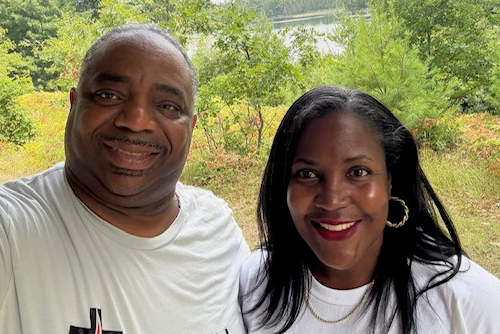
Cox’s story began far from East Africa. Born in Miami, he relocated to Detroit while working for CSX® and eventually met his wife, Tiffany. They’ve been married for 30 years and have three children — Niya, David Jr. and Kelli — and two grandchildren. Temple of Faith is Tiffany’s home church; Cox has worshiped there for three decades, serving 15 years as a deacon before entering pastoral ministry. When the founding pastor retired in 2019 after 54 years, Temple of Faith navigated the early pandemic with leadership “by committee,” eventually calling Cox as senior pastor two years ago.
GuideStone has resources specifically designed for bivocational and small church pastors. Learn more at GuideStone.org/SmallChurchPastor.
He’s a bivocational pastor, working as a supply chain manager for Penske Logistics® with Ford®. He holds leadership roles in the Baptist State Convention of Michigan, the Greater Detroit Baptist Association and the Michigan African American Fellowship. He also served two terms on the GuideStone Board of Trustees (including as chairperson). The relationships he formed there continue to shape his ministry.
Serving on these boards has given him valuable insight into how to better support pastors and churches, particularly in areas such as benefits and financial security. “I developed a great friendship with O.S. Hawkins,” he says. “His Pastor’s Guide to Leading and Living is one of my key reference tools.”
Uganda’s spiritual landscape is complex. As Cox puts it, there’s a lot of “noise” there. Islam has a visible presence with mosques every few miles, he notes. Witchcraft is also very prevalent. “What they call ‘doctors,’ we’d call ‘witchdoctors’ because of their methods.”
Traditional spiritual practices commonly intersect with community life. Many of the villages where Cox taught had no electricity or plumbing, and schooling is not guaranteed for poorer families. Churches often run small schools or orphanages, as much for community care as for discipleship.
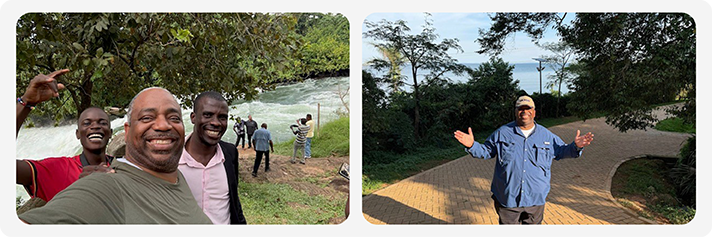
In that setting, Cox and his team provided foundational biblical teaching and practical evangelism training, introducing methods like the Three Circles for sharing the Gospel. They organized pastors’ conferences, equipped lay leaders and engaged children in learning and spreading the message of Christ. “Their hunger for the Word was incredible,” Cox recalls. “We’d teach for four hours and say, ‘Let’s take a break.’ They’d respond, ‘While you’re taking a break, we’re going to worship — and then can we learn some more?’ They just absorbed everything.”
One scene remains vivid: “There were about 200 children in one village,” he says. “We were focusing on pastors, but I watched a fourth-grade girl stand up and teach younger kids the Three Circles. No one asked her to. That’s just what she did. It showed me how deeply they take discipleship.”
The questions some Ugandans asked were equally memorable — and challenging. “They wanted biblical clarity for real-life situations,” Cox says. “One asked, ‘In my culture, I can have three wives. If I become a Christian, I’m told to have one, but God hates divorce. What do I do?’ Those are Holy Spirit moments. We prayed for wisdom and walked carefully through Scripture and pastoral counsel.”
Cultural adaptation also demanded humility. During one training session, a woman stepped out to take a call and returned in tears. “She said, ‘Someone in my household has died. Is it okay if I leave?’ She wouldn’t go until I gave permission because honoring a guest is so important in their culture. It was heartbreaking, and a lesson in respecting the ways people show hospitality.”
Hospitality, in fact, was everywhere. Villagers considered it rude to let guests depart without sharing a meal with them. “We were often in mud and dust, sitting on simple chairs, eating with our hands,” Cox says. “They cooked fresh foods and welcomed us like family. It reminded me of Acts 2:46, breaking bread from house to house.”
Not every moment carried joy. Near the end of the trip, Cox’s group visited a local hospital. Outside, families waited with their children for basic medicines and vaccines — treatments Americans receive so conveniently. “It was heartbreaking,” Cox says quietly. “We saw children who were dying while waiting. One girl cried; she’d lost her parent, and someone else was caring for her. It makes you grateful for what we have and determined to do more.”
The network of churches developed by George Smith showed striking strength. “You could see he’d been their Paul, and many there acted his Timothy and Titus,” Cox explains. “Some attended local seminaries, then returned to train others. The community is the church, and the church is the community.”
Yet pastors face sharp economic pressures. “They’re often unpaid,” Cox says, “and out of reverence, some villagers won’t hire pastors to work the land, believing manual labor would dishonor a man of God. So, pastors travel to other villages to earn a living while shepherding their churches.”
Cox returned to Michigan carrying more than memories. He carried a conviction. “We spend too much time on facilities and sound systems and not enough on the Gospel,” he says. “They weren’t worried about whiteboards for rooms or solar panels for electricity. They wanted God’s Word. We’ve lost our first love.”
Returning to Temple of Faith, he set four priorities for the coming year: missions, evangelism, discipleship, and fellowship. “We’re going back to basics,” he says. “That’s what this trip taught me.”
He also carried a profound sense of belonging. “From an African American perspective,” Cox reflects, “I felt more at home than I have in a long time. I saw faces that looked like people in my community. It felt like going home.”
When asked what he’d say to church leaders considering international missions — especially through organizations like IMB — Cox doesn’t hesitate. “Be prepared and trust the plan,” he says. “IMB knows the needs. Don’t try to do everything. If your role is to water, then water faithfully. Stick to the plan God’s already working through.”
His favorite Scripture for this season is Acts 1:8 (CSB), “But you will receive power when the Holy Spirit has come on you, and you will be my witnesses in Jerusalem, in all Judea and Samaria, and to the ends of the earth.”
He also recalls how lonely Elijah felt in 1 Kings 19. God reminded him that he was not alone; a remnant of the faithful remained in Israel. “I felt like part of that remnant,” he says, “sent to encourage believers who thought they were alone — and to bring that fire back home.”
“This trip changed my life. Sometimes you go somewhere intending to help others, only to realize it was you who benefited the most.”
In the Parable of the Talents (Matthew 25:14–30), God calls us to steward our resources in a way that honors him.
With GuideStone Wealth Management®, you'll receive faith-aligned advice and personalized strategies to help you steward your wealth with wisdom and purpose.
A GuideStone advisor will complete a thorough and intentional process to understand what truly matters to you. Then, we’ll build and implement a customized, comprehensive plan to help give you peace of mind and honor the Lord with your finances.
GuideStone Wealth Management and GuideStone Managed Accounts® services are fee-based services available to investors in personal investment accounts and non-ERISA retirement accounts offered by a GuideStone affiliate. An advisory fee for the service is assessed quarterly and based on total managed assets in the account with a minimum annual gross fee for Wealth Management services. These fees are in addition to the underlying mutual fund fees used in providing the services. Advisory services are offered through GuideStone Advisors®, an SEC Registered Investment Adviser. Registration with the SEC as an investment adviser does not imply a certain level of skill or training. GuideStone Advisors is a controlled affiliate of GuideStone Financial Resources®. For more information about the firm, products and services, please review the GuideStone Affiliate Form CRS. To learn more about our firm and investment professionals, visit FINRA’s BrokerCheck.
GuideStone, its affiliates, and financial advisors do not provide legal, tax, or accounting advice. You should consult your legal and/or tax advisors before making any financial decisions.

 Article