In the morning, you check the headlines and see the market has dropped overnight. By lunch, it’s rebounded, but by dinner, it’s dipped again. It’s a cycle that can leave even the calmest investor feeling anxious. In moments like these, it’s tempting to make quick decisions, like pulling out when things look grim, with the hope of jumping back in when they seem good. But letting fear drive your investment choices can lead to costly mistakes. Rather than reacting to market volatility, choosing to stay invested with a long-term plan is often the most effective way to build lasting financial resilience.
Market volatility refers to the frequent — and sometimes sharp — ups and downs in market values over brief periods. Short-term factors like fresh economic reports and sudden geopolitical events can shift investor sentiment and drive these fluctuations.
While these movements can feel unsettling, they are a natural part of the investing landscape. Instead of letting fear drive you to react to every market swing, focus on what truly matters: your financial plan. Your plan should be anchored on long-term goals like retirement, education or legacy giving, not daily headlines. Because it’s designed to weather storms over the long run, your focus should remain on the long-term view.
It’s natural to want to “do something” when markets get rocky. But timing the market — jumping in and out based on fear or headlines — can be costly.
Consider this: If you had invested in the S&P 500® from 2005 to 2024 but missed just the 10 best days in the market, your returns would have been cut by more than 40%. Even more surprisingly, those best days often come not long after the worst ones.
Trying to wait for the “right time” to re-enter the market can be especially challenging because no one knows in advance when recoveries will begin. Staying on the sidelines may feel safer in the moment, but it can increase the risk of missing meaningful rebounds
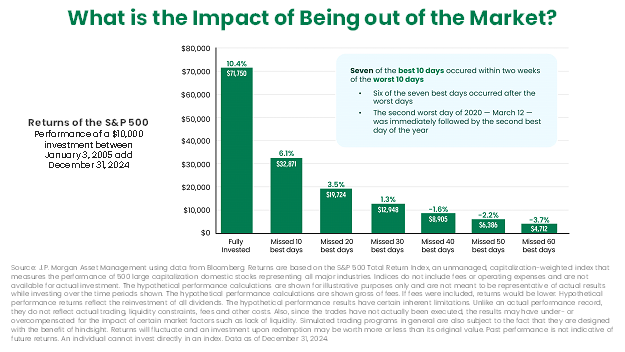
This is why staying invested in the market is so important — even when it feels uncomfortable. While past performance doesn’t guarantee future results, the market has proven resilient over time. When evaluated over the long run, the market has been friendly to investors, yielding far more positive returns than negative ones.
So, how do you stay the course when the market feels like a roller coaster? Keep these principles in mind:
Volatility is normal. It’s not a sign that something’s broken — it’s a feature of the market. The key is understanding your risk tolerance and ensuring your investment allocation is in sync with it. Everyone’s comfort level with risk is different, and that’s OK. What matters is having a plan that fits your long-term goals and sticking to it.
Even the most seasoned investors can get rattled during turbulent times. That’s where a trusted financial advisor comes in. An advisor can bring objectivity, experience and a steady hand. They can help you stay focused on your goals and avoid emotional decisions.
No strategy removes uncertainty from investing. But for many investors, discipline matters more than prediction. Choosing to stay invested in the market reflects a commitment to long-term stewardship rather than short-term speculation.
Rather than reacting to every headline, remaining focused on your goals — and the principles behind your plan — can help you navigate market volatility with greater confidence and clarity. If you have questions or want to review your strategy, we’re here to help.
For more information, contact us at Info@GuideStone.org or 1-888-98-GUIDE (1-888-984-8433), Monday through Friday, from 7 a.m. to 6 p.m. CT.
 Article
• Jun 22, 2026
Article
• Jun 22, 2026